

Performance Review Examples, Phrases and Questions for Managers
Performance review examples for each rating, phrases for strengths and problems, questions to ask in the meeting, and a simple way to write each review in about an hour.





By Allisha McCartney17 Mar 20265 min read
One of the most common leadership challenges I see in growing organizations is this: a great employee in the wrong seat. When that happens, most leaders assume they’re dealing with a performance issue. The instinct is to add more coaching, more structure, or more accountability. But in many cases, the real issue isn’t the person. It’s the role.
I once worked with a company that had a long-tenured employee everyone respected. They were loyal, hardworking, and had deep institutional knowledge. The kind of person every organization values. They would do anything asked of them.
But over time, the business grew. As it grew, their role quietly evolved into something very different from the job they originally excelled in. No one formally redefined the position. No one stepped back to assess whether the role still aligned with the employee’s strengths. The expectations simply… shifted.
Eventually, the signs started to show:
From the outside, it looked like performance was declining. So leadership responded the way many do:
But nothing improved. Because the root issue hadn’t been addressed.
Instead of continuing to push harder, we stepped back and asked a different question: Is this still the right seat for this person? That question shifted the entire approach. Instead of focusing on fixing the employee, we evaluated:
The solution wasn’t to remove the employee. It was to redesign the role. We created a position that better aligned with both the company’s current needs and the employee’s natural strengths. Then we redistributed some of their previous responsibilities to another role that was better suited to handle them.
Within a few months, the impact was clear:
Nothing about the employee’s work ethic changed. Nothing about their commitment changed. The only thing that changed was the alignment between the person and the role.
This is where many organizations get stuck. As companies grow, roles evolve, but they rarely evolve intentionally. Instead, responsibilities accumulate, expectations shift, and complexity increases. Eventually, the role outgrows the person who was once perfectly suited for it. At that point, leaders face a choice: they can push the person harder, or they can redesign the role more thoughtfully. The best organizations choose the latter.
If you’re a leader, here are five practical ways to assess whether you might have a “wrong seat” situation on your team:
Roles often look very different than they did a year or two ago. Write down the top 5–7 outcomes the role is responsible for today, not what the job description says.
Ask yourself: Do their natural strengths align with the core responsibilities? Or are they constantly working outside of their strengths? Sustained misalignment leads to burnout and inconsistent results.
When effort is high but results are inconsistent, it’s often not a motivation problem. It’s a mismatch between the work and the person.
High-performing teams adapt quickly. If other employees are regularly stepping in to “help,” the team may already be compensating for a misaligned role, whether anyone has formally acknowledged it or not.
A simple question can reveal a lot: “What part of your job gives you the most energy right now, and what part drains you the most?” Patterns in those answers often point directly to misalignment.
Great organizations don’t just hire great people. They continually ensure those people are in roles where they can succeed. Because sometimes the best thing you can do for a great employee isn’t to push them harder. It’s to make sure they’re in the right seat.
If you’re seeing performance issues on your team, it’s worth pausing before jumping to conclusions. Instead of asking: “How do I fix this person?” Try asking: “Has this role outgrown the person who’s in it?” That one shift in perspective can change everything.
If you're unsure about the alignment of your team, consider reaching out.
Subscribe to my newsletter
Join my email list to hear when I release new HR resources for small businesses, plus Colorado HR updates.
Thanks, you're on my list.

Performance review examples for each rating, phrases for strengths and problems, questions to ask in the meeting, and a simple way to write each review in about an hour.

Read more
Constant firefighting usually isn't a time management problem. It's a process problem, and HR process improvement is how you fix it.
Read more
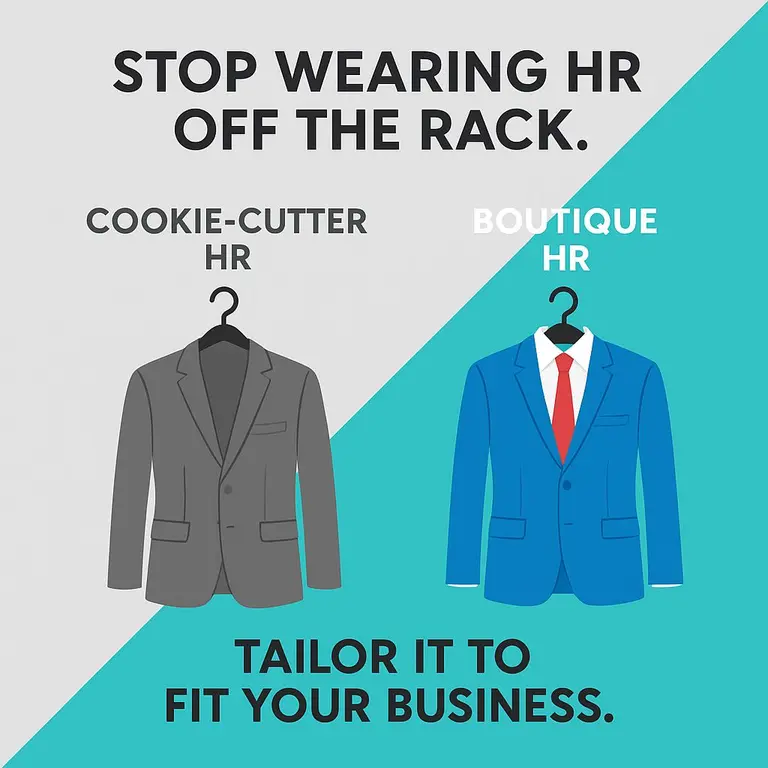
Why boutique HR consulting, tailored to one business at a time, beats one-size-fits-all HR packages for small companies.
Read moreHR Fit Check
Tell me a little about your team and I'll point you to the service that fits your business and the way of working together that suits you.
Take the Fit CheckTake the Fit Check