
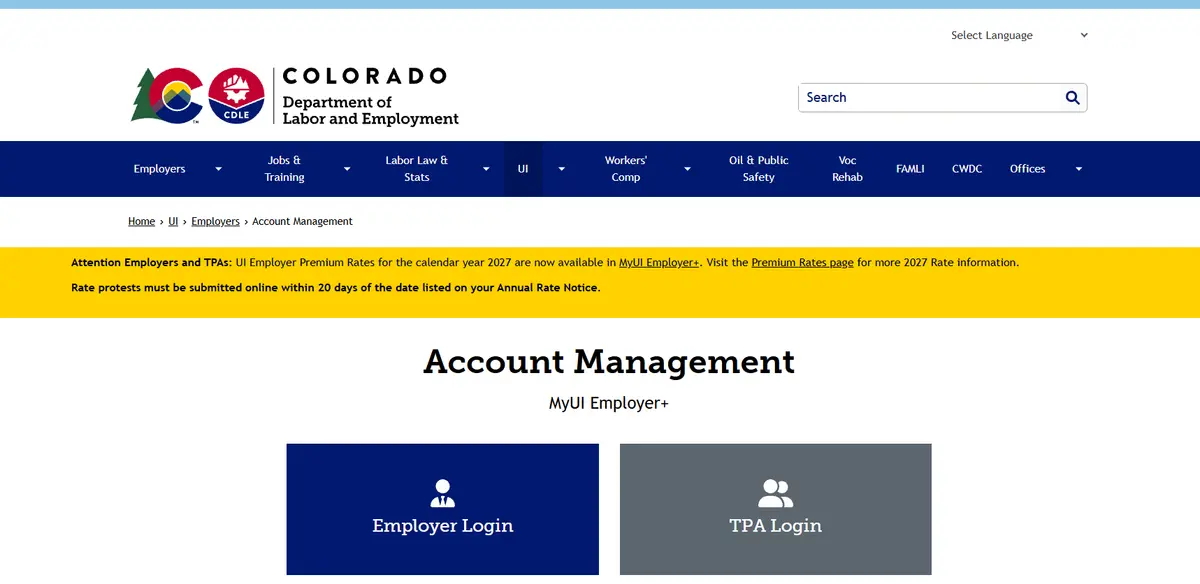
Colorado Unemployment Rate Notices
A short review of the Colorado unemployment rate notices businesses receive, what they mean, and what to do about them.






Ending someone's employment is a hard spot for any owner or manager, and the questions come fast. Do you need a reason? When is the last paycheck due, and is unused vacation part of it? What could turn this into a legal problem later?
This post stays on the employer's side of that decision in Colorado. If you're working through a performance or conduct problem instead, my posts on performance improvement plans and insubordination at work cover those steps.
Colorado follows the employment at will rule. The Colorado Department of Labor and Employment (CDLE) sums it up in its guide to retaliation protections: under that rule, employer decisions can be for any reason, whether fair or unfair, unless the employer agreed to something else, such as firing only for good cause or only after progressive discipline.
The same notice says various laws prohibit employer actions with certain motives, so no short list covers all of them. The main limits to check every time include:
Other laws protect specific acts too. In a letter to employers, the Chief Justice of the Colorado Supreme Court says employers cannot threaten, coerce, or discharge an employee for reporting for jury duty as summoned. If the real reason for a firing is that the person did something a law protects, such as reporting for jury duty or claiming their wages, you're taking a real legal risk, so get advice before you act.
CDLE explains the final pay rules in its notice on the timing of wage payments, and the deadline depends on who ended the job.
When you fire or lay off a team member, CDLE says you must immediately pay all wages owed. The rule has two exceptions:
When a team member quits or resigns, final pay is due by the next regular payday, sent to the worksite, your local office or their last known mailing address. If you send it to the worksite or your local office and the person still hasn't received it 60 days after it was due, you mail it.
Final pay means every wage the person has earned and you haven't paid yet. CDLE's summary of what counts as wages includes hourly pay, salaries, per-piece pay, bonuses or commissions earned under your agreements and vacation pay remaining when the job ends. The same summary leaves out severance pay.
Read the vacation rules closely. CDLE's vacation payout notice sets them out:
The usual deduction rules still apply. CDLE's notice on deductions from pay says some deductions are unlawful even if the team member agreed to them, including reducing pay because they resigned or were fired, didn't give notice, did unsatisfactory work or damaged company property. Lawful deductions, such as taxes or entrusted property that wasn't returned, each come with conditions, and each one has to be itemized with its amount and reason.
You can pay final wages by check, cash, direct deposit, money order or similarly secure means, as long as the person can get their entire net pay on demand at no cost. CDLE's guidance on payment methods adds that direct deposit has to be voluntarily authorized, to a federally insured bank or other financial institution the team member chooses.
If a former team member sends a written demand for wages, or CDLE sends a notice of complaint, pay everything owed within 14 days after it's sent to avoid penalties. A written demand can be informal, even a text message.
After that, CDLE's notice on penalties sets out what follows:
One more document belongs with every separation. CDLE's unemployment insurance notice tells employers they're legally required to give the form to a team member when they separate, in hard copy or electronically. For paydays, pay stubs and the rest of Colorado's pay rules, see my guide to Colorado wage and hour laws.
The legal risk in a termination comes from a decision that looks, on paper or in its timing, like it was made for a reason the law doesn't allow, or that breaks a promise you made, and that's what can turn an ordinary firing into a wrongful termination. Colorado's own law reaches small teams that the federal rules don't.
Discrimination. The Colorado Civil Rights Division says it's a discriminatory or unfair employment practice to discharge someone because of their protected class or in retaliation for protected activity. Colorado's protected classes include disability, race, creed, color, sex, sexual orientation, gender identity, gender expression, religion, age (40 and over), national origin, ancestry, marital status, and pregnancy, childbirth and related conditions. The Division also says any employee working in Colorado is covered by the state's anti-discrimination law, except at some religious organizations. The federal Title VII and ADA rules cover employers with 15 or more employees, so the state law reaches a small Colorado team first. Treat similar cases the same way, too, because the EEOC says that if two employees commit a similar offense, an employer may not discipline them differently because of a protected trait such as race, sex, age or disability.
Retaliation. Protected activities on the EEOC's list include telling a supervisor or manager about discrimination or harassment, answering questions in an employer's harassment investigation and asking for an accommodation of a disability or religious practice. CDLE's summary of retaliation protections adds claiming wage rights, using paid or unpaid leave for health or safety needs, raising workplace health and safety concerns, discussing pay rates and concerted activity such as advocacy for pay or work conditions. A team member is protected even when they're wrong about the rule, as long as their belief was reasonable, and acting against someone because you think they may complain is retaliation too.
The EEOC says protected activity doesn't shield an employee from all discipline or discharge, as long as the employer acts for reasons that aren't retaliatory or discriminatory. What matters is that the real reason is a lawful one and your records show it.
Lawful off-duty activity. Someone fired in violation of the off-duty rule can sue in court for the wages and benefits they would have earned up to the date of the judgment, and they still have to try to limit their losses. If they win, the court also awards them court costs and a reasonable attorney fee, except against a business that had 15 or fewer employees during each of 20 or more calendar weeks in the current or previous year.
Broken promises. Skipping steps your handbook, an offer letter or an agreement promised is a risk of its own, even when no discrimination or retaliation is involved.
What it can cost. For retaliation and interference, CDLE's summary lists fines, damages that can make up lost pay after an illegal firing, the attorney fees of someone who proves a violation, and orders such as reinstating a person who was illegally fired. A discrimination complaint to the Civil Rights Division has to be filed within 300 days of the person receiving notice of the decision, so your notes need to make sense to someone reading them months later.
A few habits before the meeting keep most of that risk low:
When I run a workplace investigation, every person involved is interviewed separately, by video, phone call or in person, and each interview is documented. Everyone involved signs a confidentiality form, and at the end, the leadership involved gets a written summary. In one case, with no names, a customer accused a team member of inappropriate conduct. I interviewed the customer and the witnesses first, then the team member accused, and a second issue came out during those interviews. The findings were presented to senior leadership, the team member was terminated, and I assisted with the termination.
For the day itself:
Termination process guidance and termination compliance are part of my Employee Relations & Engagement work, and I draft the actual communications for the business to use rather than a cookie-cutter template. If the former team member files for unemployment, I can help prepare your response or handle it for you completely.
If a termination is on your calendar, contact me to book a consultation.
Not under the at-will rule by itself. CDLE's guidance says an employer's decisions can be for any reason, whether fair or unfair, as long as it hasn't agreed to something different, such as firing only for good cause or only after progressive discipline. The reason still can't be an illegal one, such as discrimination, retaliation or a person's lawful off-duty activity, and those are only examples. CDLE's unemployment notice form also asks you to pick the reason the person separated, so it makes sense to have a clear, documented reason for every termination.
By the next regular payday, the same as any other resignation. Quitting without notice doesn't change what's owed: you can't deduct pay because the person didn't give notice, and if you offer paid vacation, their earned and unused vacation still has to be paid out.
It depends on how your PTO works. When team members can use it for any reason they choose, CDLE counts it as vacation pay, so every earned and unused hour is owed at the end of the job, whether the person was fired or quit. PTO that can only be used for specific events, like sick leave or bereavement, isn't owed at separation, and no policy can take away vacation someone has already earned.
Only in a limited way. If you entrusted the team member with property or money, you may take 10 days to audit that it was returned, and you can deduct for anything they failed to return only with advance written notice and the other conditions CDLE sets. Outside that, the regular final pay deadlines apply.
If a former team member sends a written demand, or CDLE sends a notice of complaint, you have 14 days after it's sent to pay everything owed. After that, penalties can apply on top of the wages: for a violation that isn't willful, double the wages owed or $1,000, whichever is greater, and more if the violation is willful. CDLE may waive penalties when you pay everything within 14 days of its notice of complaint, unless it's a second or later failure to pay within five years.
A short review of the Colorado unemployment rate notices businesses receive, what they mean, and what to do about them.

Practical employee engagement strategies for small teams. Spot the signs engagement is slipping, change a few things this month and build a simple program.

Colorado's pay transparency law applies from your first team member in the state. It sets what goes in a job posting, which promotions need a notice and how equal pay works.
HR Fit Check
Tell me a little about your team and I'll point you to the service that fits your business and the way of working together that suits you.
Take the Fit Check