

Performance Review Examples, Phrases and Questions for Managers
Performance review examples for each rating, phrases for strengths and problems, questions to ask in the meeting, and a simple way to write each review in about an hour.






You've talked with a team member about their work more than once, and it still isn't where it needs to be. You might be wondering whether it's time for a performance improvement plan, or whether a PIP is just the paperwork that comes before letting someone go. Either way, you probably want to be fair to the person and fair to the rest of your team, who may be picking up the slack.
I wrote this for owners and managers of small teams. You'll find when a PIP fits, how to manage underperforming employees before you need one, how to write a plan (there's a filled-in example) and how to see it through to the end. Used well, a PIP gives someone a clear, honest chance to turn things around, and it leaves you with a record of how you tried to help.
A performance improvement plan, or PIP, is a written plan that spells out where a team member's work falls short, what good work looks like instead, what support they'll get and how long they have to get there. It ends with a review date and says plainly what happens if the work improves and what happens if it doesn't.
A PIP is a tool for performance: results, quality, accuracy, speed and the other parts of a job you can measure or observe. It fits when the gap is clear, you've already raised it informally, and the person has the basic ability to close it with the right help and some time. It's a poor fit in a few situations:
Underperformance is easiest to fix early, while it's still a short conversation instead of a formal one. Before you reach for a plan, work through these steps:
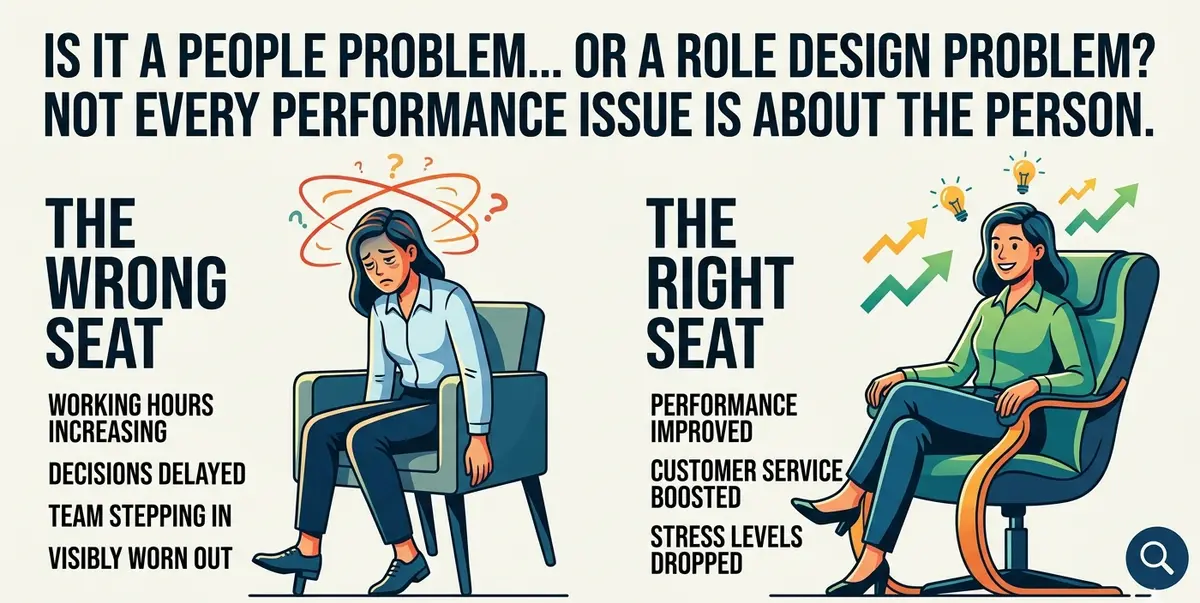
Sometimes what looks like a performance problem is a job that has changed around the person doing it. I once worked with a company whose long-tenured team member, someone everyone respected, started falling behind as the business grew and their role quietly evolved into something very different from the job they had excelled in. Leadership responded with more coaching, more structure and adjusted expectations, and nothing improved.
The leaders and I stepped back and asked a different question: is this still the right seat for this person? The fix was to redesign the role so it fit both the company's current needs and the person's strengths, and to move some of their old responsibilities to a role better suited to them. Within a few months, performance improved and stress levels dropped across the department. Before you write a PIP, ask whether the job has outgrown the person in it, because a plan aimed at the person won't fix a role that no longer fits.
Look at the timing first. The EEOC says that, depending on the facts, it could be retaliation to give someone a performance evaluation that is lower than it should be, or to increase scrutiny, because of protected activity. Its examples of protected activity include complaining to a manager about discrimination or harassment, answering questions in a harassment investigation and asking for a disability or religious accommodation. The same page says this kind of activity doesn't shield anyone from all discipline, and employers can still act for reasons that aren't retaliatory or discriminatory. A PIP can still be the right step after a complaint, as long as the performance problem is real, documented and handled the way you'd handle it for anyone else.
The federal Title VII and ADA rules cover employers with 15 or more employees. Colorado's law reaches smaller teams as well. The Colorado Civil Rights Division says any employee working in Colorado is covered by the state's anti-discrimination law, except at some religious organizations. It also says employers have a duty to provide reasonable accommodations a disability may make necessary, and that people who complain of discrimination or ask for a reasonable accommodation are protected from retaliation. If either check applies to your situation, slow down and get advice before the plan goes out.
A good plan usually fits on a page or two and reads like a fair conversation written down. It describes the work, never the person's character, and it includes these parts:
Here's a made-up example for a service coordinator at a small home services company. The names and details are invented, so swap in your own.
The plan never calls Riley careless or unmotivated. It sticks to the work, the standard and the help on offer, which makes it fair to Riley and easy for anyone to check later.
Base the length on how often the work happens. A task that comes up every day can show steady change within a few weeks, while something that happens once a month needs at least two or three cycles before you can judge it fairly. Whatever you choose, write the end date into the plan and don't stretch it quietly.
Hold the first meeting in private, with enough time set aside and a printed copy of the plan for each of you. Walk through every section, explain the support you're offering and ask the team member what they think will help them get there. Give them room to add their own comments in writing. Ask them to sign that they received the plan, and make clear that signing doesn't mean they agree with every word.
If the team member says a health condition is behind the problem, take it seriously. EEOC guidance on performance and disability says that when someone asks for a reasonable accommodation in response to a performance discussion, the employer may go ahead with the discussion but should also start talking with them about how the disability may be affecting their work and what might help. The guidance also says an accommodation never requires excusing poor performance or its consequences, and in one of its examples a supervisor postpones the start of a PIP to handle the request, then begins the plan. Accommodation questions get specific quickly, so this is a good moment to get advice before you go further.
During the plan, keep every check-in you scheduled. If you skip a meeting, the person hears that the plan doesn't matter much, and your record ends up with a gap. After each one, write a few lines on what has improved, what hasn't and what happens before the next meeting, and share them with the team member.
Deliver the support you promised, ideally in the first week. A plan where the training never happens isn't a fair test of anyone. Hold the standard steady, too: don't add new goals halfway through, and if a different issue comes up, deal with it separately. When the person is improving, tell them so at the check-in, since honest feedback runs in both directions.
Hold the review meeting on the date in the plan, and decide based on the notes you've kept rather than on how the last few days went. There are three possible outcomes:
Check your handbook before this meeting too. If it promises particular steps before termination, follow them. Ending employment has legal steps of its own, including the timing of the final paycheck, so plan those before the conversation rather than after it.
Through Training & Development, I help businesses set up performance improvement processes and coach managers through difficult conversations like these. Documentation and corrective actions, performance reviews and terminations are all part of the manager compliance training I offer. When I coach a manager, I start by asking what they're dealing with now and what they want to handle differently, and I always explain the reasons behind my advice. Instead of handing you a template, I draft the actual communications for you to use, based on your business, and I absolutely do follow-ups and check-ins afterwards.
If a performance problem on your team is heading toward a PIP, contact me to book a consultation.
Long enough for the work in question to happen several times while you watch. Daily tasks can show steady change within a few weeks, while work that comes around once a month needs a longer plan. Whatever length you choose, put the end date in writing and hold the review meeting on that date.
Start with your own handbook and any written agreements. If they promise a PIP or specific steps before termination, follow them. Serious misconduct is usually handled outside a PIP altogether. Ending employment has legal steps of its own, including when the final paycheck is due, so plan those before you act.
Ask them to, as a record that they received it and that the two of you went over it together. Make clear that signing doesn't mean they agree with everything, and give them space to write their own comments. If they decline to sign, note the date you gave them the plan and who else was in the meeting, and carry on with the plan.
Take it seriously. EEOC guidance says the employer may go ahead with the performance discussion but should also start talking with the person about how the disability may be affecting their work and what might help, and that an accommodation never requires excusing poor performance. Colorado's anti-discrimination law also gives employers a duty to provide reasonable accommodations a disability may make necessary, so this is a good point to get advice before the plan moves on.
Raise it as soon as you notice, with the same specifics and dated notes you'd use for any performance issue. Whether a slip calls for a new plan or a further step depends on what your closing note and your policies say, so when you close a successful plan, write down that you expect the improvement to last.
Performance review examples for each rating, phrases for strengths and problems, questions to ask in the meeting, and a simple way to write each review in about an hour.

Constant firefighting usually isn't a time management problem. It's a process problem, and HR process improvement is how you fix it.
Right person, wrong seat? How to tell a performance problem from an org design problem before you blame the employee.
HR Fit Check
Tell me a little about your team and I'll point you to the service that fits your business and the way of working together that suits you.
Take the Fit Check